Umbrella canopy
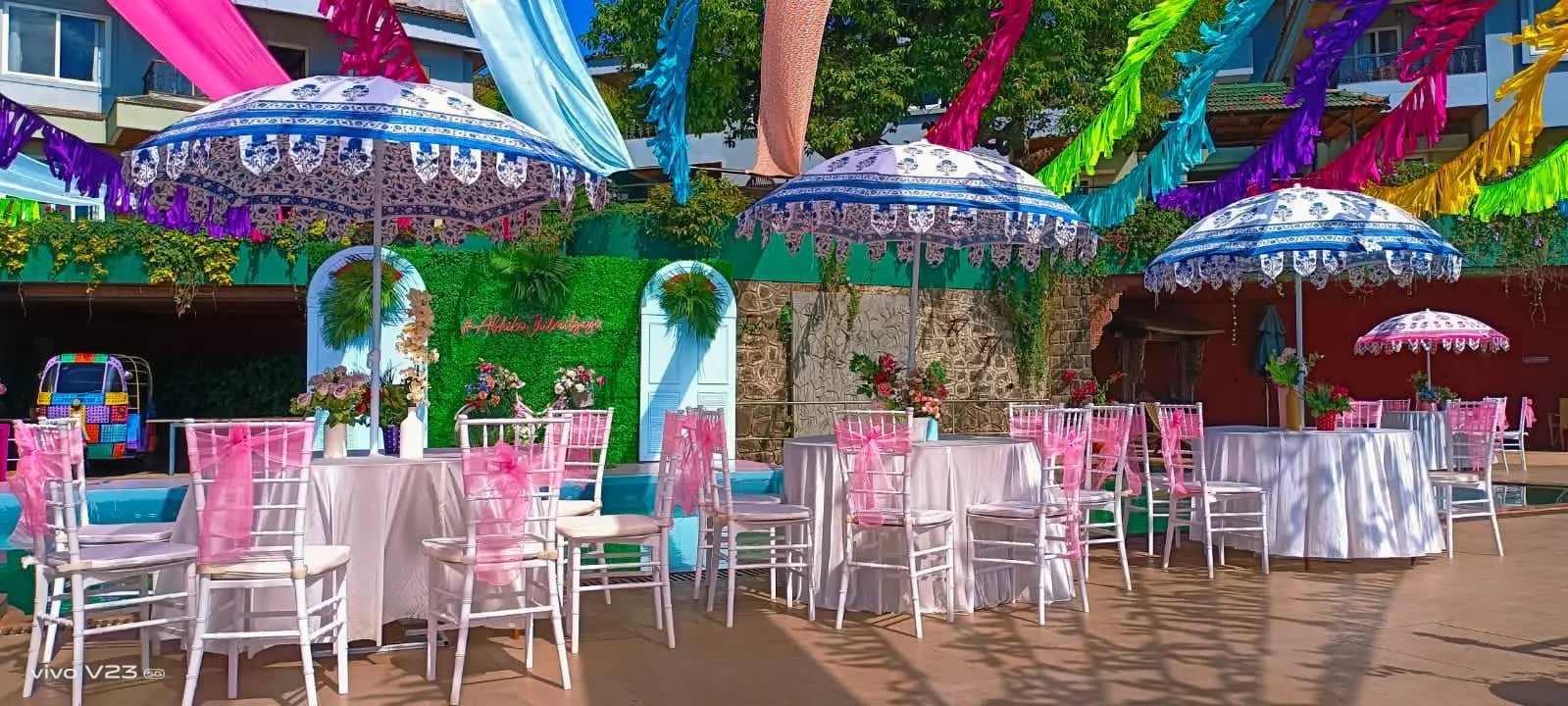
Open umbrellas hung in layers overhead, weighted at the base outdoors so a breeze cannot turn them into sails.
+91 84858 38274 · +91 84858 38219
Shop 7, Ekta Nagri, Near Dwarka Apartment, Anand Nagar, Pune 411051
Guests sit for hours at a mehendi, so the setup has to be comfortable, well lit and out of the sun. We build the backdrop, the swing, the seating and the artist stations, then run the afternoon.

A mehendi is the only wedding function where guests sit still for hours, and the décor has to be built for that. Nobody is walking past a backdrop here. They are sitting under it with wet hands, unable to hold a glass, waiting their turn and talking. Comfort, light and space matter more than they do anywhere else.
So the plan starts with seating and artist stations, and the pretty part goes on top of that. Low seating with bolsters for the guests who want it, and real chairs for the elders who cannot manage the floor. Cushion covers in dark or patterned fabric, because mehendi stains white and does not wash out. Shade and moving air by day, task light at every artist's hands by night, because fine work cannot be done under mood lighting. Straws in every drink, since nobody can lift a glass.
We have been running events since 2013. We plan, set up and run mehendi setups on terraces in Baner, society lawns towards Viman Nagar and banquet floors around Aundh.
Open umbrellas hung in layers overhead, weighted at the base outdoors so a breeze cannot turn them into sails.
Mirror panels, pompoms, bells and hand-block fabric, which throws light around and photographs well from below.
A jhula on a rated frame with fresh flower dressing, set at a height where the bride's feet reach a footrest.
Dhurries, bolsters, floor cushions and low tables in dark patterned fabric that will not show stains.
Woven charpoys with cushions in small clusters, so groups can sit together instead of in one long row.
String lights and lanterns overhead, task lights at the stations, and a cover plan in case the sky turns.
An indoor setup with a raised seat and backdrop, planned around the hall's rigging rules and session hours.
Palms, banana leaf and brass, or a soft pastel palette, for families who want less colour and more calm.
The list below is what we set up before a single photograph gets taken.
Umbrella canopy, mirror panels, tassels or florals behind a seat with a back rest, footrest and somewhere to keep a drink.
A jhula on a rated frame or approved fixing, tested with weight before the flowers go on and the seat height set properly.
Dhurries, bolsters and charpoys for the floor, with a row of proper chairs along the edge for anyone who needs one.
Neutral bright light at each station, aimed so an artist's own hand does not throw a shadow across the work.
Canopy or shamiana by day, pedestal fans angled to move air past guests rather than at wet mehendi, side flaps in the rains.
Frames the night before, flowers in the morning, a coordinator through the function, and everything cleared afterwards.
Every photo here is from an event our team planned and ran.
Where it is, whether it runs in daylight or after dark, how many guests are getting mehendi, and how many artists are coming.
You getA brief the design can be built on
We mark the bride's seat, the artist line, the walkway, elder chairs and the photo corner, then design the backdrop around that.
You getA layout plan and an itemised quote
Fixing points confirmed with the venue, or a standing frame planned instead, with the load checked and the seat height set.
You getA swing that is safe to sit on
Structures, seating and flooring go in the evening before, so the morning is only fabric, flowers and lights.
You getA build that finishes on time
Stations set, lights checked against the decorative lighting, a coordinator on the floor, and everything struck afterwards.
You getAn afternoon that runs itself
Plan where people will sit before you plan what they will look at. At a mehendi the guests stay in one place for hours, which is the opposite of every other function, and a setup designed only for photographs falls apart by the second hour.
Work out three seating groups before anything else. The bride, who will be in one spot for a long stretch and needs a back rest, a footrest, somewhere to put a phone and a drink she can reach with a straw. The guests getting mehendi, who need a seat at a height the artist can work at and a place for their bag. And the elders, who need real chairs with backs and arms, in shade, close enough to see everything that is happening.
Low seating is the look everybody asks for, and it works as long as it is not the only option. Dhurries, floor cushions, bolsters and a charpoy or two give the function its character. Behind them, along the edges, put a row of ordinary chairs. Nobody will announce that they cannot get up off the floor, and everybody is quietly grateful the chairs are there.
One detail that saves an argument later: mehendi stains fabric a deep brown and it does not come out. Keep cushion covers, dhurries and seat covers dark or patterned. White looks beautiful for the first forty minutes.
The signature looks here are the hanging ones: a canopy of open umbrellas, mirror-work panels, tassels, pompoms, bells and strings of marigold. They photograph well because they fill the frame above people's heads. Two rules make them behave. Nothing hangs at head height over a walkway, and anything hung outdoors is weighted or tied at the bottom, because a breeze turns an umbrella canopy into a set of sails.
The swing is a structure, not décor. A jhula that people will sit on has to take real load, so the frame is rated for it, the fixing points are checked, and the whole thing is tested with weight before flowers go anywhere near it. Set the seat height so the bride's feet reach a footrest instead of dangling, and cover the ropes or chains where hands will hold them. If the venue will not permit a ceiling fixing, the swing stands on its own frame, which is heavier and takes more floor than families expect. Our mehendi décor ideas post shows the looks; this page is about what sits under them.
Mehendi is fine detail work and it cannot be done under warm dim lighting. This is the most common complaint at an evening function: the room looks lovely and the artists are squinting.
Plan two layers. Task light at every station, neutral and bright, placed so the artist's own hand does not throw a shadow across the work. Then decorative light everywhere else: warm uplights, string lights, lanterns, whatever the design calls for. The two do not fight if the task lights are tight and aimed downward rather than flooding the space. Check them with the decorative lighting switched on, not in an empty hall at three in the afternoon.
Daytime functions have the opposite problem. Direct sun makes cones run and makes everyone miserable, so shade comes first: a canopy, a shamiana or a tree line, with pedestal fans placed to move air past people rather than straight at them. A fan pointed at wet mehendi blows dust into it.
A mehendi usually runs from afternoon into evening, so the build happens the night before and that morning. This is the order it comes together in.
| When | What happens | What gets checked |
|---|---|---|
| Evening before | Frames, the swing structure and any rigging go up; flooring and seating are laid | The swing is tested with weight, empty frames are checked for wobble |
| Early morning | Fabric, umbrellas, mirror panels and tassels dressed onto the frames | Nothing hangs at head height over a walkway |
| Midday | Fresh flowers dressed last, garlands and strings hung | No flower work is left sitting in direct sun before guests arrive |
| Two hours before | Artist stations built: seat, stool, side table, cones, tissue, task light | Every station lights up with the decorative lighting also on |
| One hour before | Lighting focused, fans positioned and angled, sound levels set | Fans move air past guests, never at anyone's hands |
| Half an hour before | Cushions straightened, drinks and straws stocked, the name list started | Elder chairs are in shade and close to the action |
| Through the function | Cone refills, stations wiped down, fan angles, drinks carried round | Nobody is waiting without knowing their turn |
If a haldi runs at the same venue earlier that day, the turnaround is the hard part. Yellow comes down, the floor is cleaned and a completely different colour story goes up, usually inside two to three hours with guests already in the building. It is doable, and it has to be planned as its own job rather than assumed. Our wedding decorators page explains how the functions are sequenced.
Give each artist a proper station: a seat for them, a seat for the guest, a small table for cones and tissue, and a light. Put the stations along one edge in a line rather than scattered through the middle, keep a clear walkway behind them, and start a written list of names as guests arrive. A list turns a scrum into a queue, and a queue with a number on it is a different experience altogether.
What moves the quote, roughly in order: the size and height of the backdrop and canopy; the number of hanging elements, because each one is rigged individually; whether a swing is included and whether it can be hung or has to stand on its own; fresh flower volume against the season; how much seating is being laid; lighting, which is a bigger line for an evening function than families expect; cover for shade or rain; and access, since a terrace with a small lift takes far longer to build than a lawn a tempo can reach.
Send us the venue, the date and a rough headcount and we will put an itemised sheet together. If the sangeet follows the same evening, say so, because the sangeet night planning guide covers what changes when the two run back to back.

Can't find yours? Call or WhatsApp — a planner answers.
A backdrop and a seat for the bride, low seating for guests, chairs for elders, shade or cover, lighting, and artist stations with their own task lights. Hanging elements like umbrellas, mirror panels, tassels and florals sit on top of that. A swing is usually an add-on, because it needs a rated frame and testing.
Only if it is built as a structure rather than as décor. The frame or fixing has to be rated for real load, the points checked, and the whole swing tested with weight before any flowers go on. Seat height should let the bride's feet reach a footrest. If the venue bans ceiling fixings, it stands on its own frame.
Each artist needs a station: a seat for themselves, a seat for the guest, a small side table for cones and tissue, and a light. Line the stations along one edge with a clear walkway behind, rather than scattering them. Add space for the people waiting, which is usually the part that gets forgotten.
We set up and run the décor, and when we are planning the wedding we coordinate the artists along with every other vendor, so the number booked matches the guest list and the hours available. If you have already booked artists, tell us how many are coming and we will build the stations around them.
In two layers. Bright neutral task light at each artist station, aimed so their own hand does not shadow the work, and warm decorative light everywhere else. Mood lighting alone makes fine detail impossible, which is the usual complaint at evening functions. Test both together, with the decorative lights on, not in an empty room.
The size and height of the backdrop and canopy, and the number of hanging elements, since each one is rigged separately. Then whether a swing is included and how it is supported, fresh flower volume against the season, how much seating is laid, lighting for an evening function, cover, and access at the venue. Send the venue for an itemised quote.
Yes, and the changeover has to be planned as its own job. Yellow comes down, the floor is cleaned properly because turmeric travels, and a different colour story goes up, usually inside two to three hours while guests are still in the building. Ask for both together, since the crew is already on site.
Freestanding frames, because most terraces do not allow drilling, and a canopy for shade or a light rain cover. Keep hanging elements weighted against the breeze, use string lights overhead with task lights at the stations, and check the lift size early, since backdrops then have to arrive in sections and be assembled upstairs.
Pune · PCMC
Haldi · Mehendi · Sangeet · Pheras · Reception
Weddings · Birthdays · Stage décorSend the venue, we will send the layout
Tell us where the mehendi is, what time it starts and roughly how many guests are coming, and we will come back with a design and a quote.