Monthly social sets
Offers, greetings, announcements and story frames drawn as one set, so the feed looks planned rather than assembled.
Shop 7, Ekta Nagri, Near Dwarka Apartment, Anand Nagar, Pune 411051
We handle the steady stream of design a business needs every month: posts, brochures, standees, decks and print files. Repeat items become templates, and everything else gets drawn fresh.
Graphic design is the work that happens after your brand already exists. Every week there is an offer to announce, a stall panel to size, a deck for a client meeting, a menu update, a hoarding for a launch. None of it is a rebrand. All of it has to look like the same company, and most of it carries a deadline measured in days.
We take that load on. Anything that repeats becomes an editable layout your team can fill quickly, and anything new gets drawn properly. Files leave in the format the person receiving them actually needs, so a printer in Pimpri-Chinchwad, a vendor cutting flex and your sales coordinator are not all asking you for a different version of the same thing.
Events are our main business, so we are used to artwork that must be right the first time. A backdrop goes up once, and a wrong edge shows from the front row. That habit carries straight into everyday jobs.
Offers, greetings, announcements and story frames drawn as one set, so the feed looks planned rather than assembled.
Multi-page documents for products, services and tenders, laid out to work both on a press and as an emailed file.
Roll-ups, backdrops, flex panels and hoardings built to the exact fabrication drawing before anything is printed.
Pouches, sticker labels and box artwork prepared on the printer's die line instead of a guessed rectangle.
Sales and investor slides rebuilt so spacing, charts and type behave the same way from first slide to last.
Panel artwork, hanging signage and counter branding matched to the drawing your stall fabricator supplies.
Menu boards, service lists and rate cards built as layouts you can revise yourself each season.
Entry boards, floor stickers, directional arrows and desk names for offices, showrooms and large venues.
Whether you take a retainer or buy jobs one at a time, these six parts stay the same.
Requests are logged, prioritised and given a return date, so nothing sits forgotten in somebody's inbox.
Editable layouts for offers, greetings, certificates and rate lists that stay correct when a non-designer fills them in.
Fresh design for campaigns, launches and anything a layout cannot carry, drawn inside your existing brand rules.
Bleed, crop marks, colour mode and resolution set properly before a file reaches any printer or fabricator.
The same idea rebuilt for feeds, stories, mailers, website banners and slides instead of stretched to fit.
Working files and finals stored under clear names, so next year's team can open and edit them.
Tell us the date, the guest count, the budget and the feeling you want in the room. We ask the questions most people forget.
You getFirst ideas and a budget range
Theme, décor, stage layout and a minute-by-minute run of show, drawn up and revised until it feels like yours.
You getMoodboard, layout and an itemised quote
Venue shortlists, caterers, artists, anchors and the paperwork — police, music licences and venue approvals — handled by us.
You getLocked vendors, one point of contact
Décor goes up, truss and LED walls are rigged, sound is checked and the anchor rehearses every cue with our show caller.
You getA walk-through before guests arrive
Our crew runs the floor, the stage and the guests. When it is over, we clear the venue and send you the photos.
You getA calm host — you — and the memories
Ongoing design is a supply problem before it is a creative one. Drawing the thing is rarely the hard part. Keeping up with a business that needs artwork every week, in the right format, before a date somebody already promised a customer — that is the hard part. Plan for it and the work stops feeling rushed.
Your identity is decided once; artwork is produced forever. Choosing the logo, palette, type and the rules that hold them together is a separate project, and it lives on our branding page, which covers identity, guidelines and the signed-off file set you keep at the end. This page picks up everything that comes after that. When the identity is settled, production design moves fast, because each new job inherits decisions somebody has already argued out. When it is not settled, every small job quietly turns into a fresh debate about colour.
Look at a year of your artwork and most of it repeats. Festival greetings, offer posts, new-joiner announcements, certificates, price lists, invites. Those deserve to be built once as editable layouts, with type sizes, margins and logo position locked so nobody can drag them out of shape. A coordinator can then produce a correct-looking post on a Saturday evening without waiting for a designer. Save the custom effort for work that earns it: a campaign visual, a launch look, a stall panel, a cover that has to stop somebody walking past.
A file that looks right on your laptop can print muddy, and a file built for a press can look washed out in a feed. The differences are dull and they matter. Colour is mixed differently for ink than for light, printing needs image area beyond the trim edge so the blade never leaves a white sliver, and anything read from across a room needs far bigger type than anything read in the hand. This is how we set up the common jobs.
| What you are making | Where it ends up | Colour set for | The check before you approve |
|---|---|---|---|
| Feed post or story | A phone, held at arm's length | Screen | Still readable at thumbnail size, with sound off |
| Brochure or profile | Offset press, folded | Ink | Facing pages reviewed as spreads, never as singles |
| Standee or roll-up | Large-format flex | Ink | Nothing important sits below knee height |
| Stage backdrop | Fabricated panel | Ink | Logo stays clear of the truss and the speaker |
| Pitch deck | Projector and laptop | Screen | Smallest label legible from the back row |
| Label or carton | Die-cut press | Ink, with a spot colour checked | Statutory text sits inside the safe area |
When a printer or fabricator sends a drawing, we build to that drawing rather than a standard size. A stall at one hall and a stall at another rarely share panel dimensions, and last-minute resizing is exactly where errors creep in. Our exhibition stall work follows the same rule.
A monthly retainer buys designer time, not a fixed pile of files. Two things consume it faster than clients expect. The first is revision rounds: a job approved in one pass costs a fraction of the same job pushed through four opinions. The second is late briefs, because artwork wanted tomorrow displaces something else and often has to be redrawn once the real information arrives. A shared queue shows what is in progress, what is waiting on you and what is closed, so the month never ends in a surprise. Before a big push — a sale, an expo, a launch week — we agree in advance whether it fits the retainer or is quoted separately.
Can't find yours? Call or WhatsApp — a planner answers.
Graphic design cost depends on how much of your output repeats and how much has to be drawn from nothing. A layout built once and refilled every month behaves very differently from a campaign visual invented for a single launch. Page count, print preparation, the number of sizes each idea needs and the revision rounds you expect all move the effort. Send a normal month's list and we will scope it.
A retainer reserves you design time each month, while per-job billing buys one finished item. Retainers suit steady, predictable output such as weekly posts, monthly offers and regular brochures, because the queue keeps moving without a fresh quote every time. Per-job suits occasional needs like one catalogue a year. Plenty of businesses run both: a small retainer, plus separate quotes for large campaigns.
You should receive a press-ready file and the editable working file for everything that gets printed. The press-ready version carries the bleed, crop marks and ink colour your printer expects. The editable version matters months later, when a number changes or a line is added, because it saves redrawing the piece. Ask for both at handover and keep them in a company folder.
Yes, and it makes everything quicker. Send whatever exists: a guideline document, older artwork, the fonts you licensed, your logo files. We design inside those rules rather than inventing new ones. Where the guidelines say nothing, which is common for story sizes and stall panels, we propose an approach, get it approved once, and apply it the same way afterwards.
Urgent artwork depends on whether an approved layout already exists for it. A post or certificate built from a locked template can come back the same working day. A brochure, stall panel or campaign visual needs drafting time and at least one review round. We commit to a return date when the job is logged, so you are never guessing where it stands.
Yes, a large share of our work ends up on something physical. Standees, backdrops, flex panels, stall graphics, signage, labels and cartons are all prepared to the fabricator's or printer's own drawing. Running events has taught us that artwork is judged from across a hall, not on a laptop, and that changes type size, contrast and where a logo can safely sit.
You own it. Final files and the editable working files are handed over, named and foldered so another designer could continue without ringing us first. Keep them on a shared company drive rather than one employee's machine. Licensed fonts and purchased images stay governed by their own licence terms, and we tell you which of those apply to each piece.
Pune · PCMC
Pune · PCMC
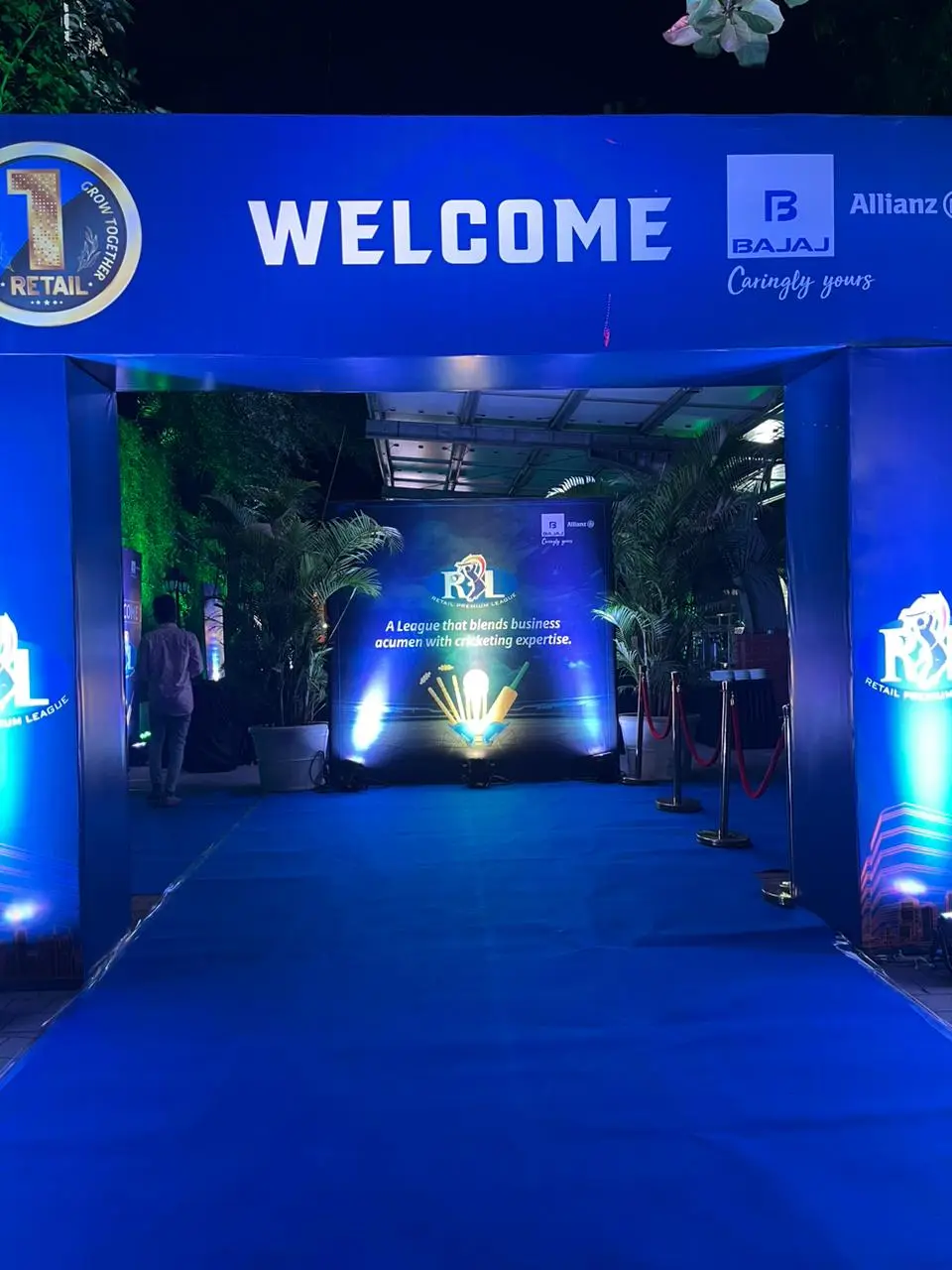
Welcome gates · Backdrops · BoothsPlanning events in Pune since 2013 — 500+ events for 100+ brands across 30+ cities. Read what clients say on Trustpilot, or find our Anand Nagar office on Google Maps.
Great EventGautam
User friendly experienceRahul Roushan
This company made sure to take care of everythingVaishnavi Todkar
Best Event Planner.Pranali Ladkat
Detailed workMolly Vernon
Send us a normal month
Tell us what you publish and print in an average month, and we will suggest templates, a retainer or both.