Product launch event production is the technical build behind a launch: stage, set, screens, sound, lighting, the reveal mechanism and the show call. It runs in sequence, from technical recce and drawings through fabrication, load-in, focusing and rehearsal, to the live cue stack and strike on the same night.
A launch looks like one continuous moment to the audience: lights dim, a film plays, a curtain drops, the product is there. Behind that is several weeks of drawings, fabrication, trucks, cable and rehearsal, arranged in an order that barely varies from one launch to the next. This piece walks through product launch event production the way it is built, from the first visit to the empty hall to the last case leaving the loading bay.
Planning this in Pune? See our product launch event: one team plans and runs it with you, since 2013.
What production covers, and what it does not
Production is everything the audience sees and hears, plus everything holding it up. Stage and set, the screens and what plays on them, sound, lighting, rigging, power, the reveal mechanism, the crew, the cue sheet and the person calling it.
It is worth being clear about what sits outside it, because launches go wrong in the gaps. Your product’s story, the invitation list, the media relationships, the pricing announcement and the sign-offs on what may be said on stage all remain with you. A production team can tell you a film has to be delivered by a certain Tuesday; it cannot decide what the film says.
The build, phase by phase
The work falls into seven phases, and each one has a hand-off from your side that unblocks it.
| Phase | What the production team is doing | What the brand hands over |
|---|---|---|
| Concept and scale | Translating the reveal idea into a stage shape, a screen size and a crew size | The reveal moment, the audience split and a budget band |
| Technical recce | Measuring the venue, testing power, checking rigging points and access | The confirmed venue and a contact there |
| Drawings and specification | Producing the plan, elevation, screen layout, lighting plot and equipment list | Approval of the drawing set, and brand artwork |
| Fabrication and prep | Building the set, printing graphics, prepping and testing equipment off site | Final logos, colours and product dimensions |
| Load-in and focus | Rigging, stacking, cabling, aligning screens, focusing lights, tuning sound | The product unit itself, and access to it |
| Rehearsal | Running the cue stack with real content, real speakers and the real reveal | Final films, decks and the people who will be on stage |
| Show and strike | Calling the show, then dismantling and clearing the venue | A decision-maker present who can approve a change |
The technical recce
Nothing can be priced honestly before somebody stands in the empty room. A drawing made from a banquet brochure will be wrong about the one thing that matters.
What gets measured
- Ceiling height and rigging points. These set the maximum screen height and whether trusses hang or stand on towers, which changes both the look and the cost.
- Load limits. The floor, the roof and any lift have limits the venue will state in writing.
- Power. How many amps the venue can give, from where, on what phases, and what happens when the supply drops.
- Access. The loading bay height, the width of every door on the route, the lift dimensions, and whether the route crosses a public area that can only be used at night.
- Sightlines. Where the pillars are, where the seating goes and which seats cannot see the reveal.
- House rules. Sound limits, curfew, what may be drilled, taped or hung, and which surfaces must be protected.
In Pune this matters more than people expect. A hotel ballroom in Koregaon Park and a converted industrial shed on the outskirts need entirely different plans for the same launch, and the difference is usually power and access rather than square feet.
Drawings, and why they are the real agreement
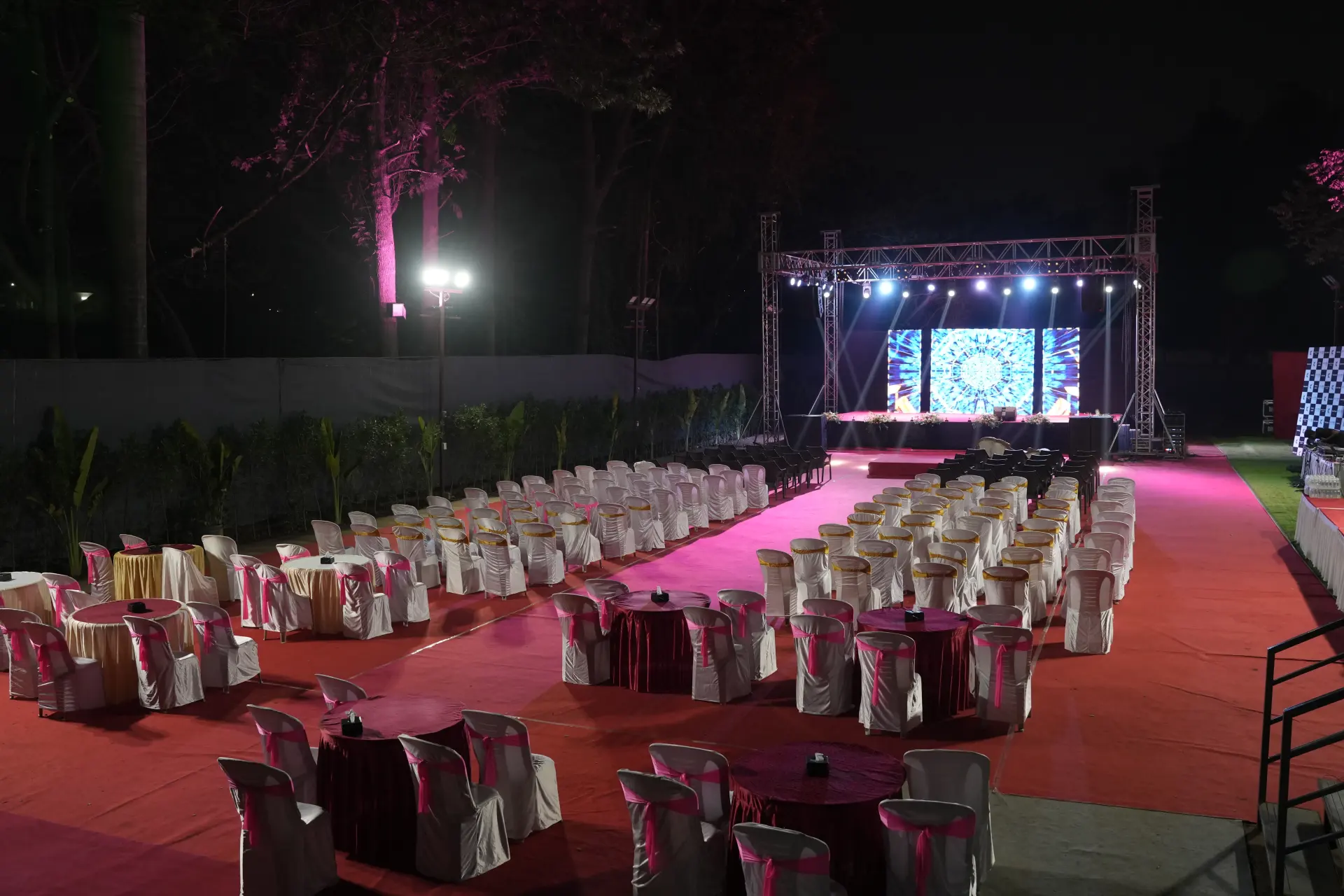
The drawing set is where the launch becomes specific. A plan view showing the stage, seating, camera positions and the walkway. An elevation showing exactly how tall the set is and where the logo sits. A screen layout with pixel dimensions, so every film is made in the correct ratio. A lighting plot listing each fixture and its position. An equipment list naming what will actually be on site, including the spares.
Read that set properly before approving it. It is easier to move a screen on paper than on the morning of the event, and every later change has a cost attached because something has already been built or booked.
The set and the reveal mechanism
The reveal is the one moment everyone will remember, so it is designed first and rehearsed most. The mechanism you choose changes the whole build.
- Drop curtain or kabuki. A fabric panel released on a cue. Simple, reliable, and dependent on there being enough height above the product.
- Sliding or rotating panels. A set piece that opens on a track. Handsome, but it needs motors, a crew member on standby and a manual override.
- Lift or turntable. The product rises or turns into view. The heaviest option, and the one that most needs a full-weight rehearsal.
- Screen reveal. The screen splits, lifts or goes transparent to show the product behind it. Very clean, and dependent on precise alignment.
- Projection and light. The product sits in the dark and is simply found by a beam. Cheapest to rig, hardest to light well.
Whichever is chosen, agree the fallback in the same conversation. Every motorised reveal needs a way for a person to open it by hand if the cue fails, and that person needs to have practised it.
Screens, sound and light
Screen size is set by the furthest seat, not by the budget line. Work out what the person in the back row must be able to read, then size the display to that and build the content to the exact pixel dimensions you were given. Films arriving in the wrong ratio on the day is the most ordinary technical failure at a launch, and it is entirely avoidable.
Sound is divided between speech and playback. Speech needs even coverage and enough microphones, including a spare handheld sitting ready at the side of the stage. Playback needs headroom so the reveal track lands as a physical thing rather than a loud one. Lighting has three jobs: make the speakers look well, keep the product reading cleanly on camera, and turn the room over at the reveal. The third is what the audience feels, and it lives in the cue stack rather than in the equipment list.
Load-in, focus and rehearsal
Load-in usually starts the night before, or very early on the day, because the venue rarely gives a full day. The order is fixed: rigging first, because nothing may happen underneath a truss going up; then screens and set; then cable and lighting focus; then sound tuning; then furniture, branding and seating last, so they are not walked over.
The technical rehearsal is the part clients are tempted to shorten, and it is the part that decides the evening. A real rehearsal means the actual films, the actual deck, the actual speakers walking the actual route, and the reveal fired at least twice. Anything short of that is a conversation about a rehearsal.
Calling the show
One person calls the show, and everyone else takes their cue from that voice. The show caller works from a cue sheet listing every light state, every sound and video roll, every mic and every set move, in order, with the trigger for each.
The crew is on a closed communication channel: sound, lighting, video, stage and the person minding the reveal. A launch where the brand team also talks on that channel is a launch where two people give different instructions at the same second. Keep one named person from your side beside the show caller, empowered to decide, and route every request through them.
Press, cameras and the stream
Press positions are part of the drawing, not an afterthought. Photographers need a riser or a marked area with a clean view of the reveal, and they need to know the moment it happens. A clean audio feed and a video feed should be available from the desk so coverage is usable rather than filmed off a phone.
If the launch is being streamed or recorded, that decision changes the lighting, the camera positions and the stage width, so take it early. Our hybrid event production page covers what an online audience needs, and a formal media session usually sits better as its own short format, which the press conference page explains.
Strike, and the night after
Strike is planned like load-in, in reverse, and it is usually the same night because venues charge by the day. Agree in advance who takes charge of the product unit at the end, because the most valuable object in the room should not still be on the stage while the trusses come down.
What drives production cost
Cost is driven by the size of the stage and set, the area of screen, the number of lighting fixtures, whether anything is rigged overhead, how many crew are on site and for how many hours, how many trucks are needed, and what has to be fabricated fresh rather than adapted. The venue’s access window matters too: a build squeezed into a short night needs more people to finish on time.
Nothing useful can be quoted from a phone call. Share the venue, the date, the audience size and the reveal you have in mind, and ask for a line-by-line quote against the drawing set so you can see exactly what each element costs.
Build your launch with Plan With YOLO
We plan, set up and run launch events across Pune and other cities: recce, drawings, set fabrication, screens, sound, lighting, rehearsal and the show call, with one team accountable from the first sketch to strike. Running since 2013, we have delivered 500+ events.
Send the venue, the date and the reveal you are imagining through our product launch event management page, or the contact page, and you will get back a drawing set and an itemised production quote. If the launch is a new outlet rather than a new product, our store launch page is the right starting point.
Frequently asked questions
What is product launch event production?
Product launch event production is the technical delivery of a launch: stage and set, screens, sound, lighting, rigging, power, the reveal mechanism, the crew and the cue sheet that ties them together. It starts with a technical recce of the venue and ends with strike. It does not cover your product story, guest list or media relationships.
How far ahead should a product launch be planned?
Allow eight to twelve weeks for a launch with a custom set, a motorised reveal or a large screen, and four to six for a simpler stage with a straightforward presentation. The long pole is rarely equipment. It is fabrication, venue technical approval and getting your films and decks finished early enough to rehearse with them.
Why does a technical recce matter for a launch?
Because ceiling height, rigging points, floor loading, power supply and door widths decide what can physically be built, and none of them appear in a venue brochure. A recce turns a concept into a drawing that survives the loading bay. Quotes prepared without one usually change later, which is when changes are most expensive.
What can go wrong with a stage reveal?
The usual failures are a motor that stalls, a cue fired early, a curtain that snags, or a product placed slightly off its mark so the light misses it. All four are caught by firing the reveal at least twice during rehearsal, with the real product in position. Always agree a manual fallback and rehearse that too.
Who should be in charge on the day of the launch?
One show caller from the production side runs the cue sheet, and one named person from the brand side stands beside them with the authority to approve changes. Everything else routes through those two. Launches lose their timing when several people give instructions on the crew channel at once, especially in the final hour before doors.

Vicky founded Plan With YOLO in Pune in 2013 and leads the planning on corporate events, weddings and stage production across Maharashtra.