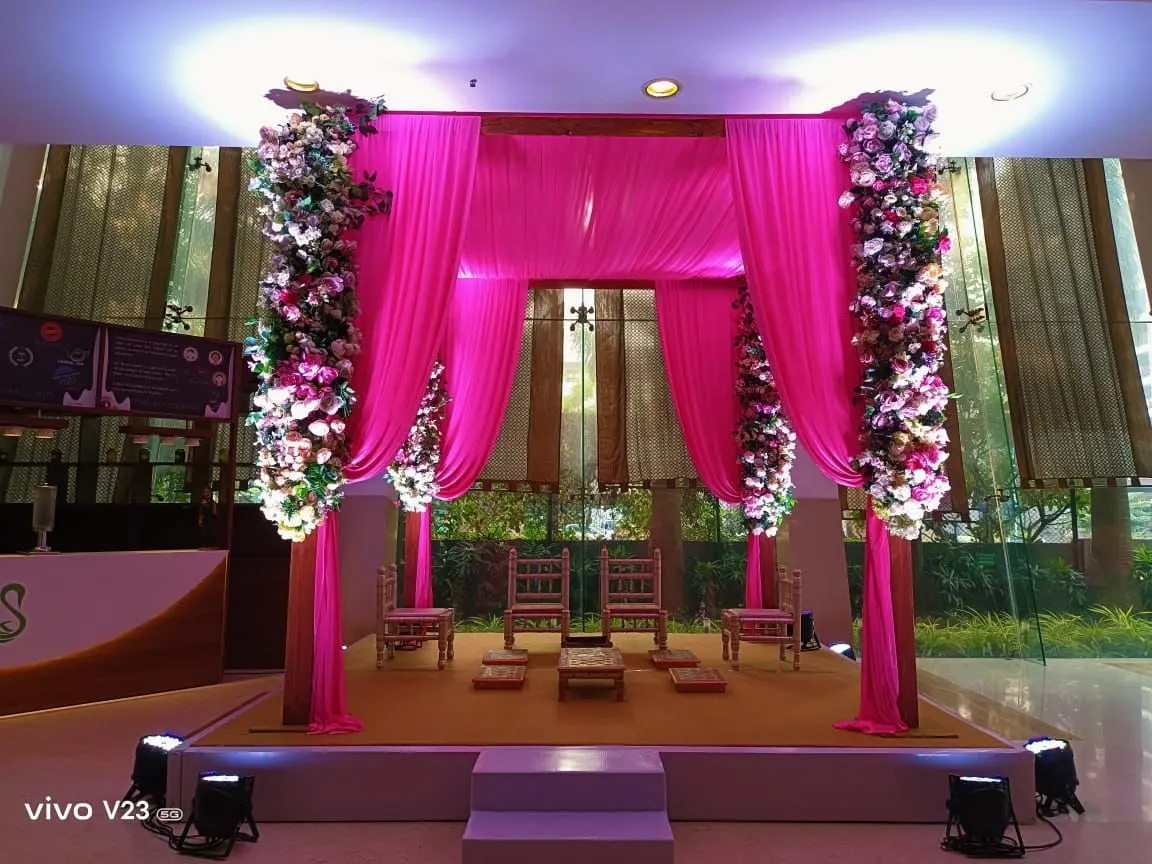

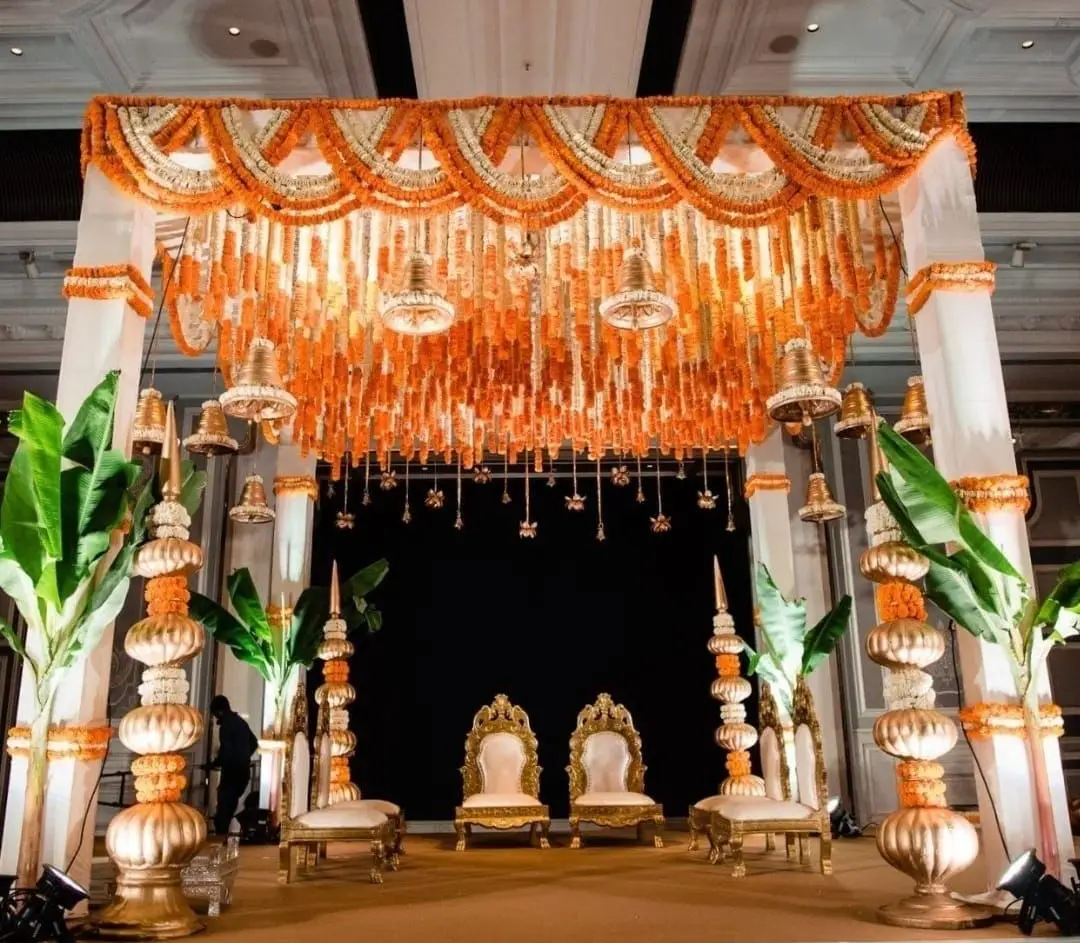
The usual order is engagement, then haldi and mehendi, then sangeet, then the wedding day itself — baraat, varmala and pheras — and the reception last. Haldi and mehendi are often the same day, haldi in the morning and mehendi in the afternoon. Most Indian weddings run across two or three days.
Families planning a first wedding ask the same question in the same order: what happens when, and how many days do we need? The answer varies by community and region, but the backbone is the same almost everywhere in Maharashtra, and knowing it is what lets you book a venue before the muhurat is announced.
Planning this in Pune? See our wedding planners in Pune: one team plans and runs it with you, since 2013.
The usual order, start to finish
- Engagement or sakharpuda — weeks or months earlier, sometimes the day before.
- Haldi — morning, at home, both families separately.
- Mehendi — afternoon and evening, usually the same day as haldi or the day before.
- Sangeet — the evening before the wedding day, often straight after mehendi.
- Baraat — the groom’s arrival on the wedding day.
- Varmala or jaimala — the garland exchange, immediately after the baraat.
- Pheras — the ceremony itself, at the muhurat time.
- Vidaai — the bride’s farewell.
- Reception — the same evening or the next, depending on the muhurat.
How many days do you actually need?
Two days is the honest minimum: haldi and mehendi on day one, wedding and reception on day two. Three days gives sangeet a night of its own and stops the second day running from six in the morning to midnight.
The muhurat decides more than preference does. A pre-dawn muhurat and an evening reception on the same day is a nineteen-hour day for the couple, and families who have done it rarely recommend it. If the muhurat is early, pushing the reception to the following evening is usually worth the extra venue cost.
How long each function really runs
Planning on the ceremony length rather than the function length is how schedules collapse. These are the realistic figures:
- Haldi — the ritual is thirty to forty minutes; the function is two to three hours with guests, food and photographs.
- Mehendi — four to six hours, and it is decided by the number of artists rather than by the schedule. One artist completes roughly five or six pairs of hands an hour.
- Bridal mehendi — three to five hours on its own, with one artist doing nothing else.
- Sangeet — three to four hours, longer if there are many performances. Rehearsed items take twice as long as people expect.
- Baraat — planned for forty-five minutes, usually ninety. It is the single most over-run item of the week.
- Pheras — forty-five minutes to two hours depending on the community and the priest.
- Reception — four to five hours, with the greeting line taking most of it.
The three places schedules break
The baraat
It starts late and moves slowly, because that is what a baraat is for. Padding it by half an hour in the run sheet costs nothing and saves the whole afternoon.
The greeting line at the reception
Four hundred guests meeting a couple one by one is two to three hours if nobody has planned the flow. Steps up one side and down the other, the photographer with a fixed spot and the gifting table off the line is the difference between guests eating and guests leaving.
Food arriving during the ceremony
Caterers work to their own timings unless somebody gives them yours. Dinner opening while the pheras are still running empties the mandap, and no family has ever been happy about it afterwards.
Regional differences worth knowing
A Maharashtrian wedding adds the seemantpujan and the antarpat before the pheras and is often finished by late morning. Punjabi weddings carry a longer sangeet and a bigger baraat. South Indian muhurats are frequently at dawn, which pushes everything else of the day later. If the two families follow different traditions, agree the combined run sheet early — that conversation is easier three months out than three days out.
Our pages on haldi, mehendi and reception setups cover what each function needs built, and wedding planning in Pune covers running them as one week rather than five separate days.
Frequently asked questions
What is the correct order of Indian wedding ceremonies?
Engagement, haldi, mehendi, sangeet, then the wedding day itself — baraat, varmala, pheras and vidaai — and the reception last. Haldi and mehendi are commonly on the same day, haldi in the morning and mehendi from the afternoon.
How many days before the wedding is haldi?
Usually one or two days before, and often on the same day as the mehendi. Both families hold their own haldi, normally in the morning, because the turmeric needs time to come off before the evening function.
Is sangeet before or after mehendi?
After. Mehendi runs through the afternoon and the sangeet follows in the evening, frequently on the same day and sometimes in the same venue with a changeover in between. On a three-day wedding the sangeet gets an evening of its own.
How many days does an Indian wedding take?
Two days is the workable minimum and three is comfortable. Two means haldi and mehendi on one day and the wedding and reception on the next; three gives the sangeet its own night and keeps the wedding day from running nineteen hours.
Can the reception be on the same day as the wedding?
Yes, and it usually is when the muhurat falls in the morning or early afternoon. With a pre-dawn muhurat it makes for an extremely long day, and most families who have done it would move the reception to the next evening given the choice again.
Which function runs over its time most often?
The baraat, every time. It is planned at forty-five minutes and takes about ninety, because a baraat moving quickly is a baraat nobody enjoyed. Build the extra half hour into the run sheet rather than hoping.
Vicky founded Plan With YOLO in Pune in 2013 and leads the planning on corporate events, weddings and stage production across Maharashtra.